



Latest articles. You can find more articles here.
Sightseeing features
The school museum of
"old school" in Eschdorf
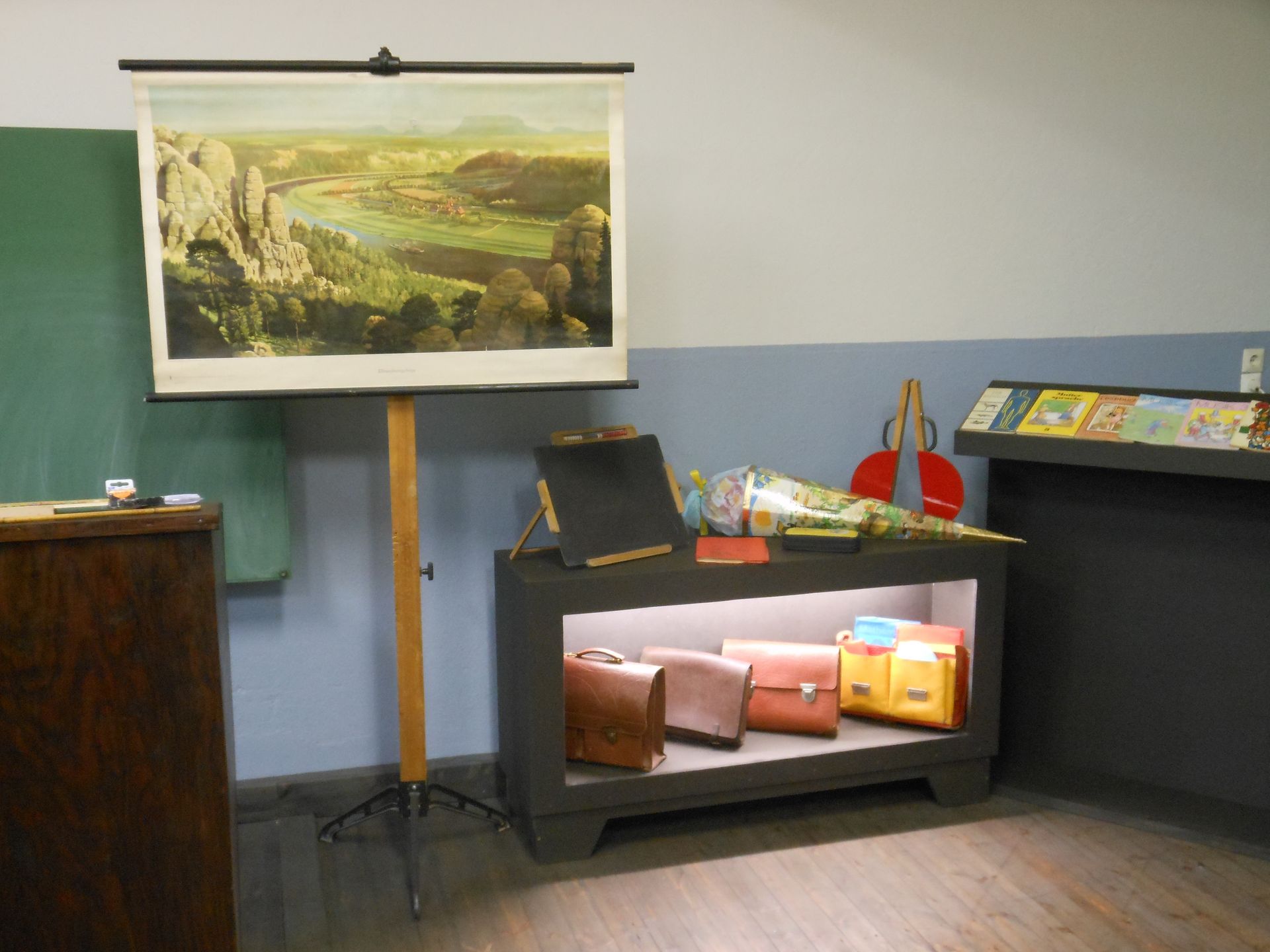
In modern times, we have many electronic tools for calculating; we have the simple ones that work without electricity, for presenting.
Did you know who worked as a teacher here around 1540, 1573, or even 1885? You can find this information here.
In fourth grade, the topic of school yesterday and today is covered. You don't have to travel far; come and see us, where you'll learn fascinating things about it. How did students dress in the past? What did teachers wear around 1930? You'll find all the answers here.
But there are also new things to admire, including the current textbook "Geography Class 5".
In this document you will also find information about the town of Eschdorf and its school museum.
When the word "school" is mentioned, some people think of an interesting time in their lives, while others think of a not-so-easy one. But everyone would probably agree that school wasn't all that bad.
Our school museum offers insights into the school's history and evokes many memories of a time we all lived through. It encompasses many facets of this period.
We display schoolbooks from bygone eras, old report cards, and also interesting items from the teachers who taught here. An interesting collection of school bags, student crafts, and the famous "Zuckertüte" (a traditional German cone-shaped bag filled with sweets and small gifts) from different periods can be found here.
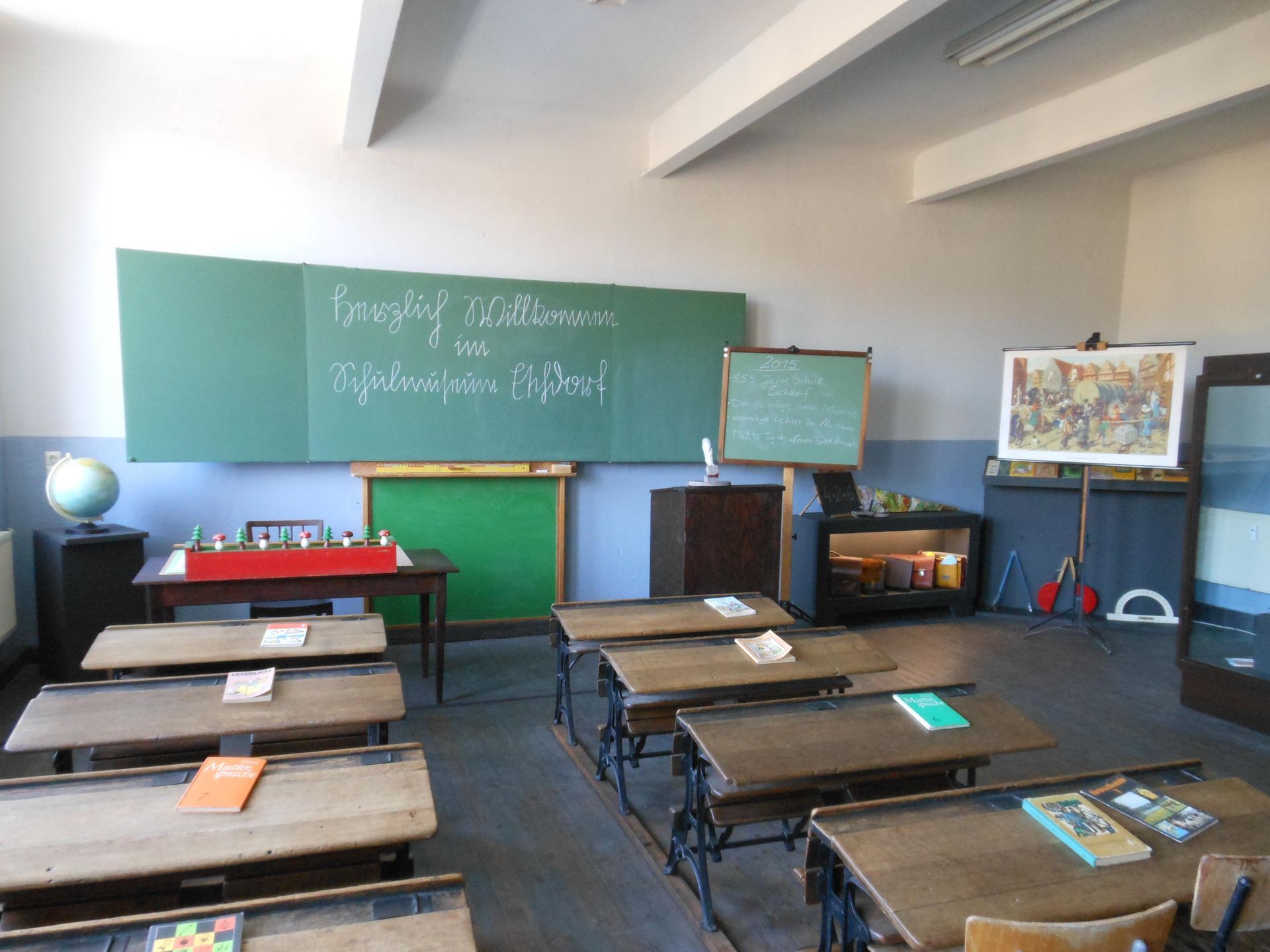
A brief glimpse into the school museum during "Open Monument Day"
A class reunion after many years of school is possible here. Enjoy a fun hour sitting at old school desks, followed by a cozy get-together in our club room.
We don't have explicit opening hours for the school museum, as we are all volunteers. Just give us a call and we'll certainly find a suitable appointment for you.
Contact person: Hans-Jürgen Rott 49 35026 955141
schulmuseum@eschdorf.de
Occupancy plan for the school museum
Contact us
Mill pavilion with drive wheel of the lower mill
At the initiative of the Eschdorf Friends Association, and in consultation with the owners, parts of the original mill mechanism from 1817 were salvaged. With support from the City of Dresden, specifically the Parks and Green Spaces Department, as well as the Schönfeld-Weißig administrative office and funding approved by the local council, the historic mechanism was partially reconstructed in 2021, and this mill pavilion was erected on Mühlgrabenweg, very close to the Bienert Mill. The pavilion's roof is modeled after the hipped roof of the old Eschdorf village smithy.
Milling operations ceased around 1920, but the mill continued to operate as a sawmill until the end of World War II. It was powered by an overshot waterwheel. The last waterwheel, presumably also dating from 1817, did not survive.

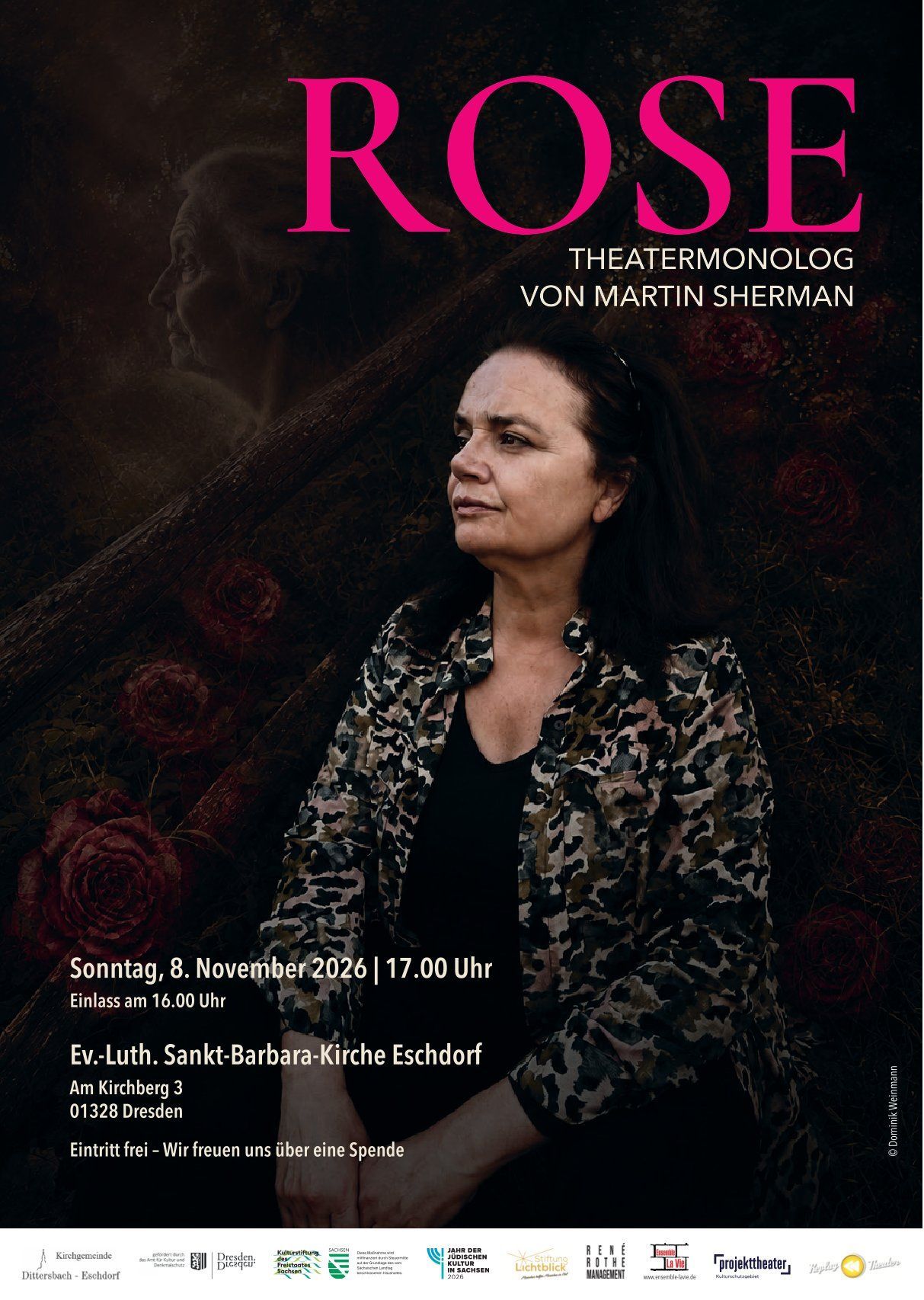
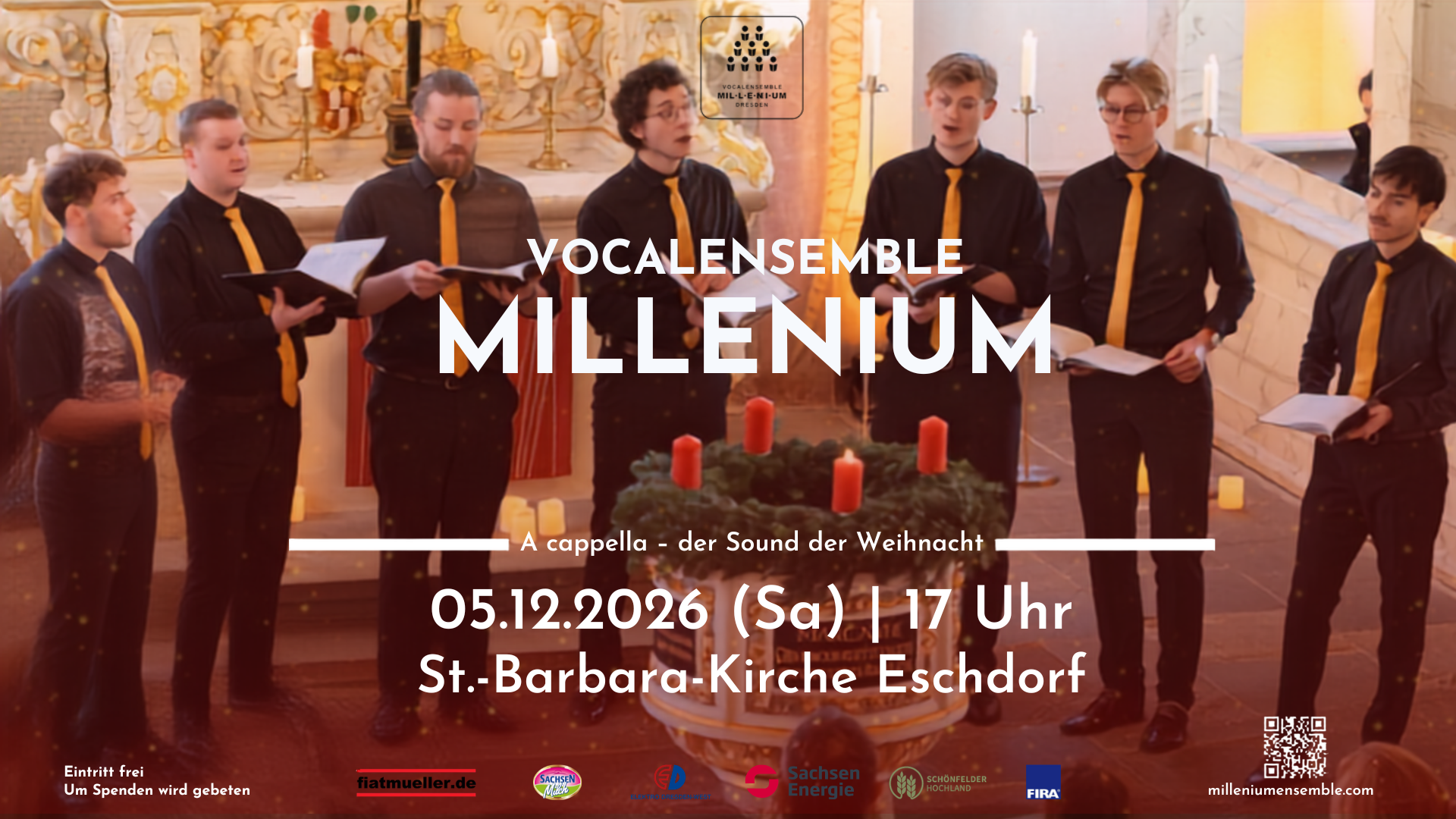
St. Barbara Church
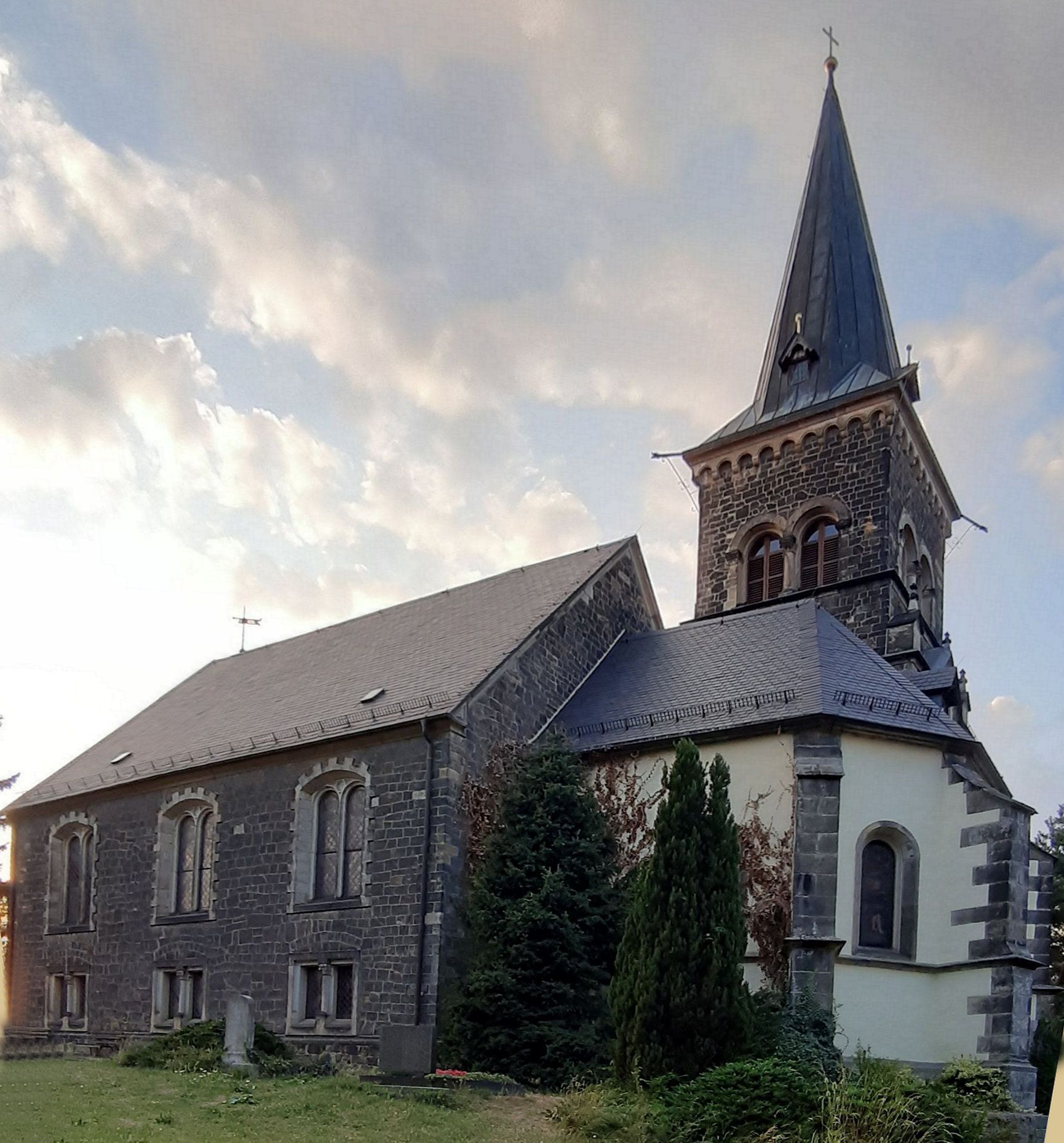
It is little known to many that the renowned Dresden mill owner and art patron Traugott Bienert was born in Eschdorf. After the early death of his father, he took over the management of the Eschdorf Upper Mill, now the Bienert Mill, at around the age of 14, working his way up from a small village miller to a famous estate mill owner. He commissioned a monument to his parents, who are buried in the Eschdorf cemetery, which still stands today directly behind the church tower, commemorating them. Traugott Bienert remained connected to his birthplace of Eschdorf throughout his life. In 1885/86, he contributed a large portion of the costs for the renovation of St. Barbara's Church in Eschdorf by architect Arnold. A bell tower with four bells was erected on top of the old mortuary chapel, which was attached to the chancel of the church. The nave was also widened (still clearly visible today when walking from the cultural barn to the church and looking at the gable of the nave). Furthermore, Traugott Bienert established a school scholarship for the poorest but most diligent children of the village, which was only discontinued around 1960. The electrification of the lighting, with its beautiful candelabras made of Lusatian glass, also dates from this period. In the mid-1980s, the church was repointed, replastered, and restored both inside and out. After German reunification, the church spire was replaced and the roof was re-covered. In 1996, for the 650th anniversary of the church's first recorded mention, the "Museum under the Attic," our local history museum, was inaugurated in the renovated attic. In recent years, the Eschdorf church has received a new oak bell frame, new tower sound louvers, a restored clock mechanism, a new, modern ringing system, and a new clock face. The St. Barbara Church in Eschdorf and its beautifully sounding bells cordially invite you to visit and to silent prayer.
The church in Eschdorf was first mentioned in the Meissen parish registers in 1346. This makes it at least 675 years old. Evidence of this period can still be seen in the chancel, particularly in the Gothic cross vault. In 1348, Luhold von Turgow donated a St. Barbara altar to the church in Eschdorf, meaning that from this point on, the church in Eschdorf became a pilgrimage church. St. Barbara was and is the patron saint of miners and of protection against lightning strikes in Catholic communities. There were never any mines in Eschdorf or the surrounding area, but because the church stands on a hill and is often struck by lightning, it became a place of pilgrimage for protection against lightning damage. And for some people, it remains so to this day, even though the church in Eschdorf has been an Evangelical Lutheran church since the Reformation in 1539. It never lost its name or its function. In later times, the local patron saints, who resided at the Eschdorf manor, became very important financial backers for our St. Barbara's Church. The von Nostitz and von Quandt families deserve special mention (both family coats of arms still adorn our baptismal font today). The latter family had a large circle of friends among Dresden's artists. Gottfried Semper, along with Johann Wolfgang von Goethe, was a well-respected guest of the Eschdorf manor. Out of gratitude and as a token of friendship, Semper designed the organ case for the Eschdorf organ, which was built in Stolpen between 1836 and 1838 by the Herbriger organ building firm. As the crowning touch to this organ case designed by Semper, two plaster angel figures by the Dresden sculptor Rietzschel, which had previously been exhibited at the Paris World's Fair, were installed in 1838.
Aerial photographs of St. Barbara's Church in Eschdorf. Alexander Claus
Here is a small glimpse of the clockwork and the bells.
Museum in the attic
Local History Museum
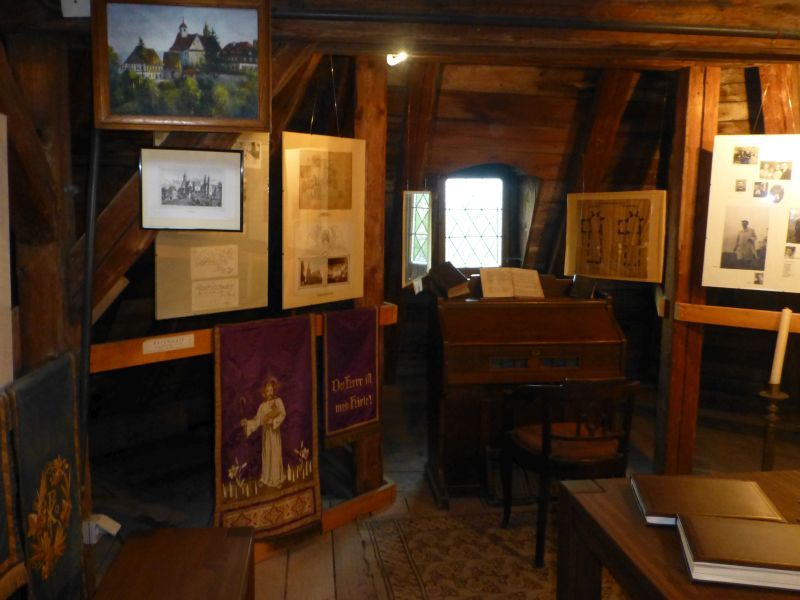
Since 1996, there has been a local history museum in the attic of the Eschdorf church. Modeled on traditional local history rooms, it provides insights into living conditions in the village at the end of the 19th and beginning of the 20th centuries. Using artifacts such as old furniture, stoves, agricultural implements, and everyday objects, a kitchen, a washhouse, a bedroom, and a living room have been recreated.
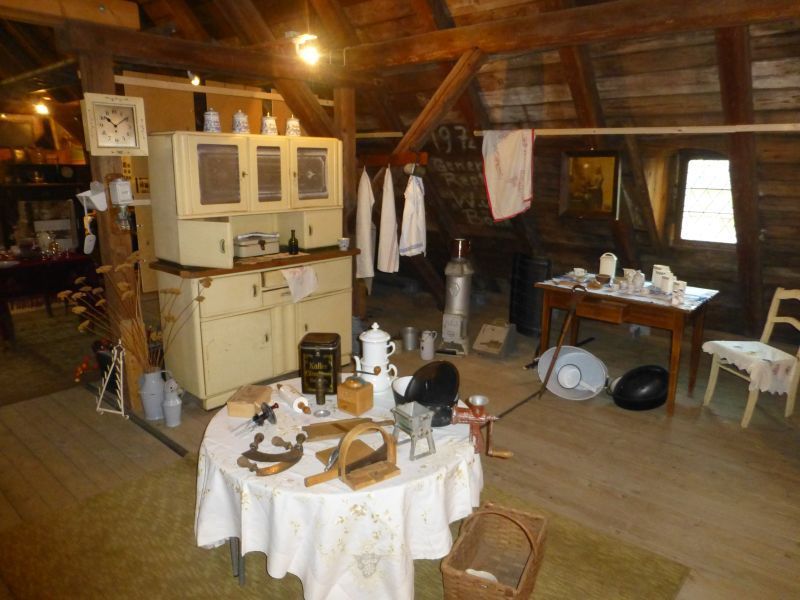
The museum's anteroom focuses on the architectural history of St. Barbara's Church. Besides the lid of a baptismal font, which was in use until 1860, and various historical views of the church, confirmation photos from nearly every year since the beginning of the 20th century are on display. Overviews of the Eschdorf pastors (some with photos) and their periods of service complement the collection. The original renovation plans for St. Barbara's Church by the Dresden architect Christian Friedrich Arnold, dating from 1886, are also exhibited here.
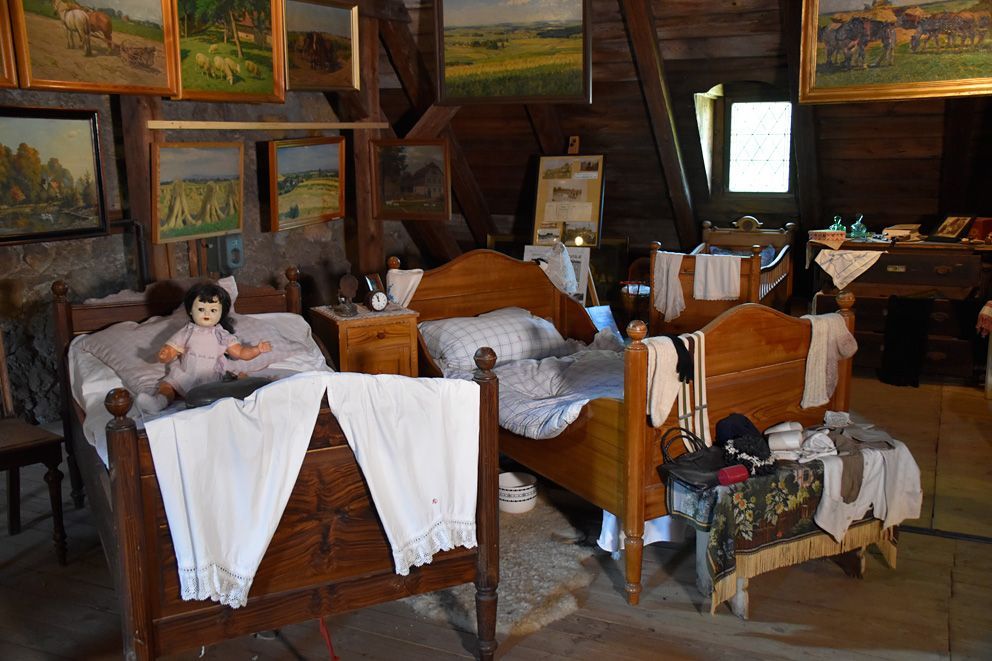
A school desk with satchel and textbooks can also be found in the museum. One corner of the museum is dedicated to the tools of craftsmen from that era. All of this is complemented by various documents and records that vividly illustrate the way of life in Eschdorf. Numerous photographs document village festivals, weddings, and parades since the 1930s.
A small gallery displays works by the painter Willi Tag (1886-1980), who found his subjects in Eschdorf and the surrounding area even before the Second World War. Many of his paintings are on permanent loan.
Clubs and businesses

Butcher shop
Sausage roll
Pappelweg 2
01328 Dresden

bakery
Hübner
Pirnaer Straße 64
01328 Dresden
Carpentry
Bernd Schäfer
Eschdorfer Bergstr. 17
01328 Dresden
Installer / Master Plumber
Andreas Marbach
Eschdorfer Bergstraße 2
01328 Dresden
Car repair shop
Teich Brothers GbR
Rosinendörfchen 2 A
01328 Dresden

Car recycling
Quast GmbH
Pirnaer Straße 97a
01328 Dresden

Piano/harpsichord maker
Robert Gormer
Spiegelweg 98
01328 Dresden
KOCH
Road and civil engineering
Kiesgrube Eschdorf

Youth club
Eschdorf eV
Bühlauer Str. 3c
01328 Dresden
Circle of friends
Eschdorf eV
Kirchberg 4
01328 Dresden

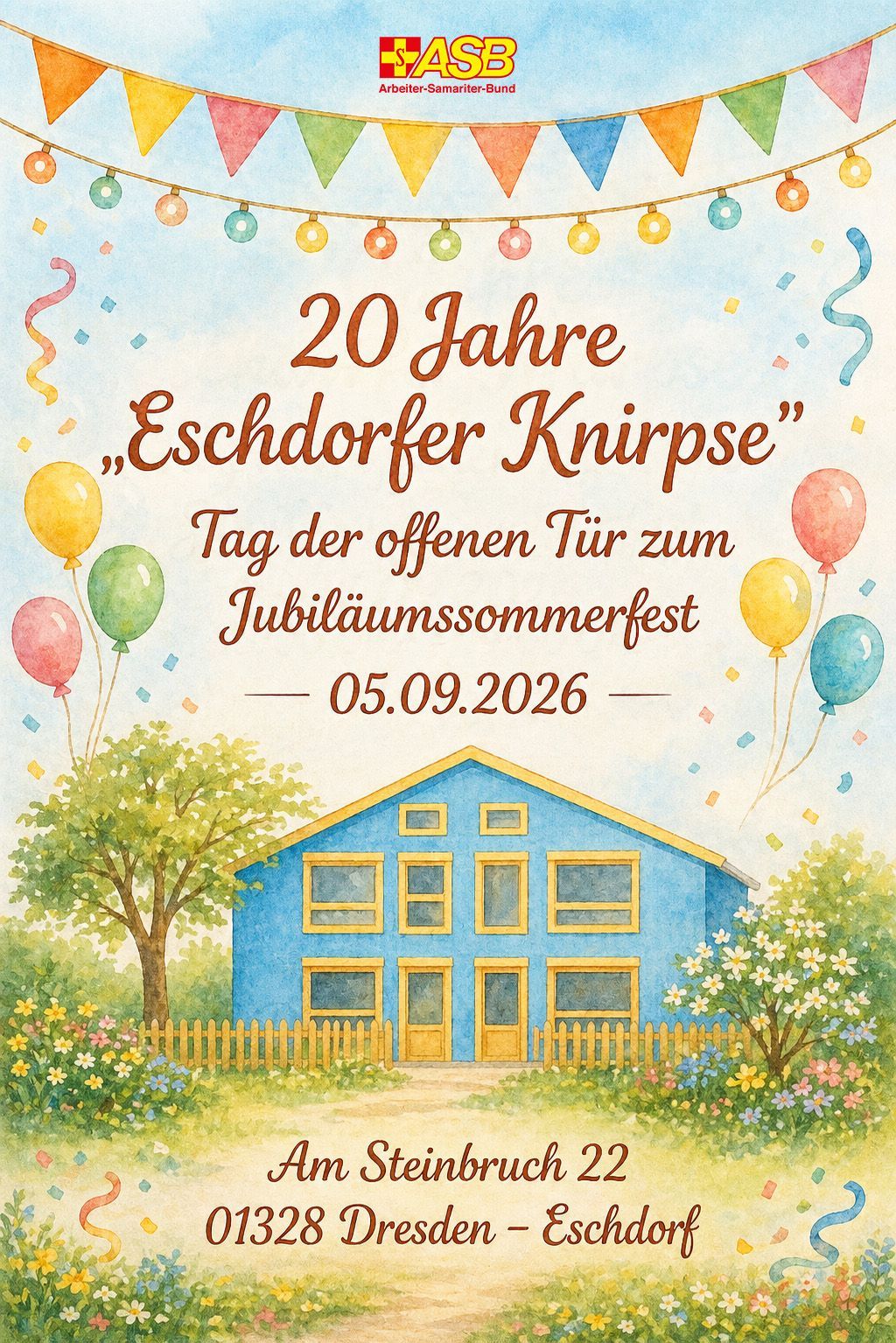
Kindergarten
"Eschdorfer Knirpse"
At the quarry 22
01328 Dresden
Fire department
STF Eschdorf
Pirnaer Str. 53
01328 Dresden

Westerntraining
Bapp
Dittersbacher Str. 4
01328 Dresden
Diving school
Frank Bernhardt
Spiegelweg 14
01328 Dresden